
Every day you hear voices, music, traffic and birdsong, almost without thinking about it. Yet behind every sound there’s a fast but amazing journey: from the air into your ear and all the way to your brain. In this article I explain simply how hearing works and why it sometimes doesn’t work as it should.
In my work I explain this almost every day: understanding how the ear works makes it much easier to understand your audiogram, and why a hearing aid has to be fine-tuned with patience.
Watch the journey of sound
1. Sound is a wave
When someone speaks or plays an instrument, they make the air vibrate. These vibrations travel as waves, a bit like the ripples in water when you throw in a stone. Fast waves are high-pitched sounds (a whistle, the letter «s»), slow waves are low-pitched sounds (a drum, a deep voice). The stronger the wave, the louder the sound seems.
2. Outer ear: collects the sound
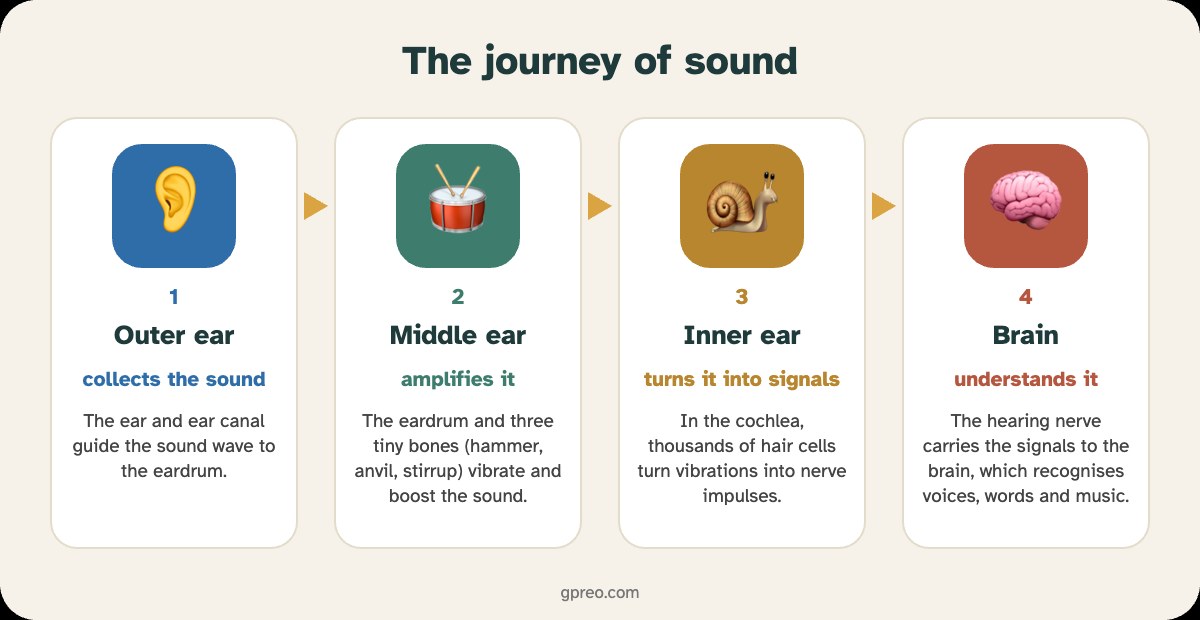
The outer ear, the part we can see, works like an antenna: it collects the waves and channels them into the ear canal. Its shape also helps us tell where a sound is coming from. At the end of the canal is the eardrum, a thin membrane that vibrates when sound arrives.
3. Middle ear: amplifies
Behind the eardrum is a small air-filled space with the three smallest bones in the human body: the hammer, anvil and stirrup. They work like a lever: they pass the eardrum’s vibrations on to the inner ear and boost them, because the sound has to move from air into fluid.
This is also where the Eustachian tube opens, the channel that connects the ear to the throat and balances the pressure: it’s what «pops» when you swallow on a plane.
4. Inner ear: from vibrations to signals
The stirrup pushes on a small window of the cochlea, a snail-shaped organ the size of a pea, filled with fluid. The vibrations create a wave in the fluid and, inside, thousands of hair cells bend and turn the movement into electrical impulses.
The cochlea is laid out like a piano keyboard: the cells for high sounds respond at the start, those for low sounds towards the tip. The cells for high sounds wear out most easily: that’s why, with age or noise, people usually start hearing high pitches less well first.
5. The brain: we hear with our brain
The hearing nerve carries the impulses to the brain. That’s where signals become words, music, the voice of someone you love. The brain also filters out background noise and lets us follow a conversation in a restaurant. That’s why we say we hear with our ears, but we understand with our brain.
What happens when hearing declines
- A problem in the outer or middle ear (earwax plug, ear infection, eardrum, tiny bones): sound doesn’t reach the inner ear properly. This is conductive hearing loss, often treatable by a doctor.
- A problem in the cochlea or the nerve: damaged hair cells don’t grow back. This is sensorineural hearing loss, the most common type, which is compensated with hearing aids.
When the cells for high sounds are missing, consonants like «s», «f» and «t» get blurred: you can hear that someone is speaking, but you can’t make out the words. And if the brain receives fewer sounds for years, it «forgets» them: that’s why it pays to act early. Want to see how all this shows up on a hearing test? Read how to read an audiogram.
💡 How to protect your hearing
- Keep headphone volume moderate: a simple rule is no more than 60% for more than 60 minutes at a time.
- Wear earplugs at concerts, in clubs and with noisy tools.
- No cotton swabs inside the ear canal (here’s why).
- Have your hearing checked regularly, especially after 60 or if you work in noise.
Want to know how well you hear?
Take the free hearing check in 2–5 minutes or write to me: I’ll reply to you personally.
This article is for information only and does not replace a medical visit or professional advice.
Was this helpful?