
After a hearing check you receive a sheet full of lines, crosses and numbers: the audiogram. Many people get it without any explanation. In this article I’ll show you how to read it, what the speech test tells you and which measurements should always be done before talking about hearing aids.
The audiogram in 30 seconds
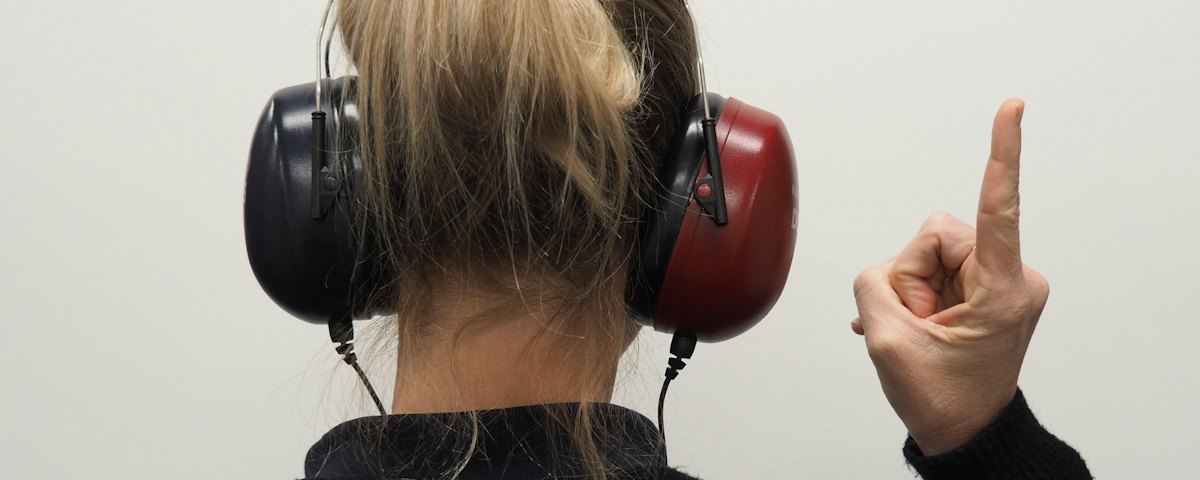
The audiogram is the result of pure-tone audiometry: in a sound booth, with headphones, you hear “beeps” at different pitches and press a button as soon as you hear them, even very faint ones. For each tone, we look for the softest volume you can still hear: your hearing threshold.
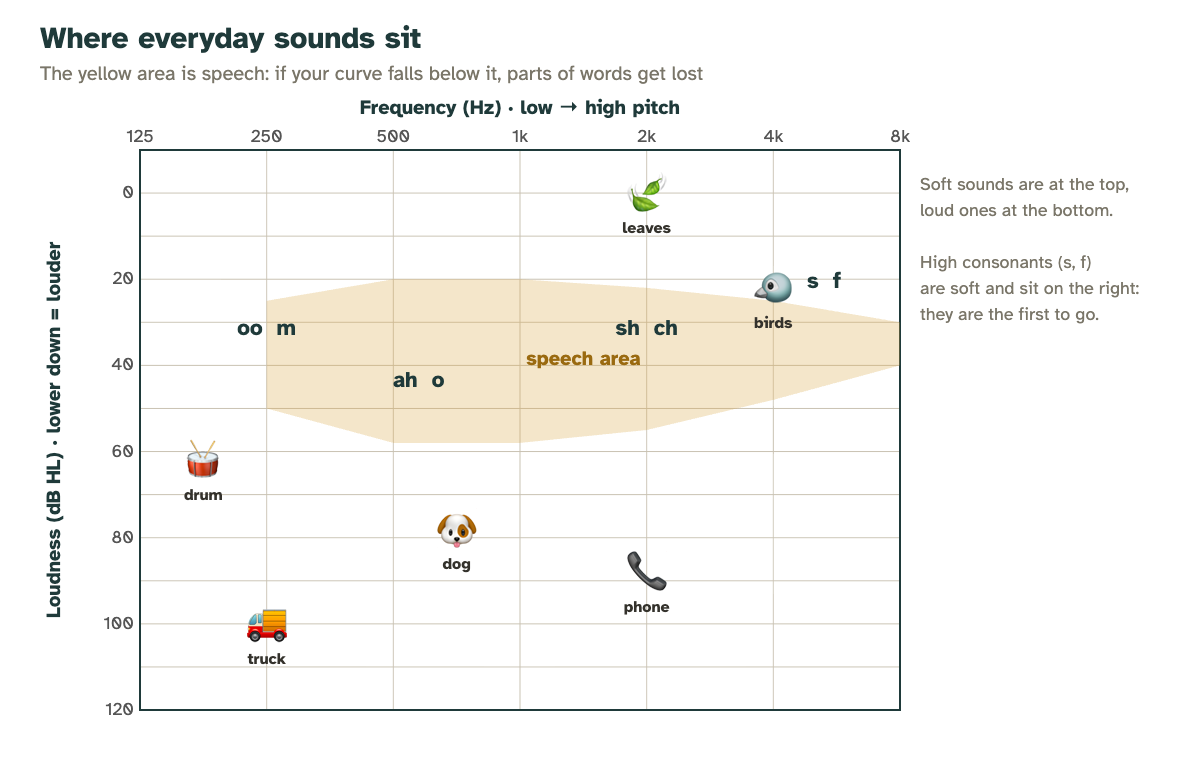
- Horizontally you see the frequencies, in Hertz (Hz): on the left the low pitches (125–250 Hz, like a drum), on the right the high ones (4000–8000 Hz, like birdsong or the consonants “s” and “f”).
- Vertically you see the volume, in decibels (dB HL): soft sounds at the top, loud ones at the bottom.
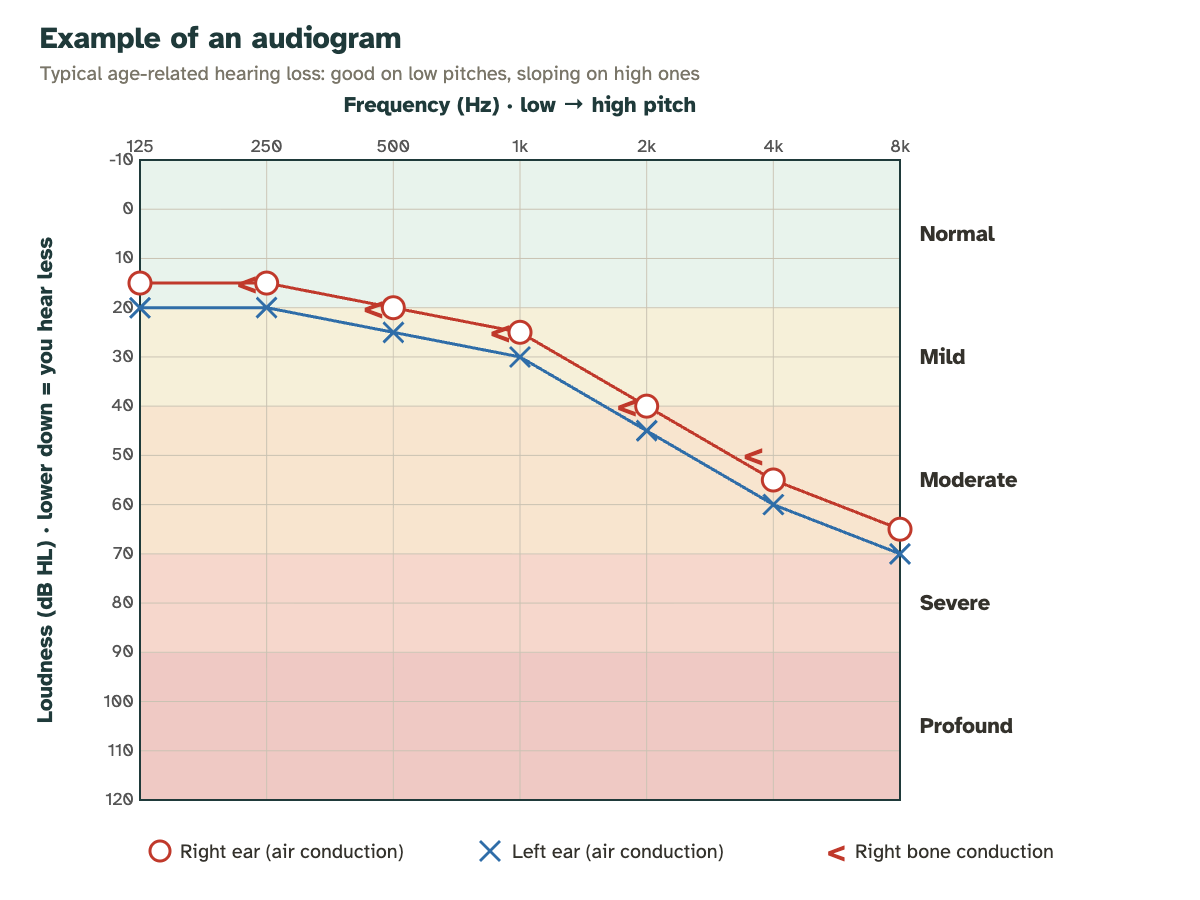
- Golden rule: the lower the line, the less you hear. A point at 60 dB means that sound has to be very loud before you notice it.
The symbols: who’s who
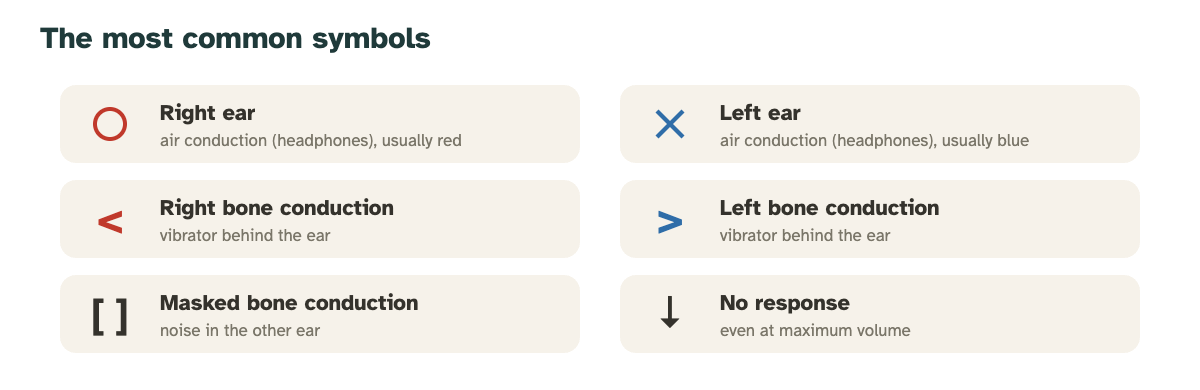
- Red circle (O): right ear.
- Blue cross (X): left ear.
- Brackets or arrowheads (< > or [ ]): bone conduction. The sound is sent through a small vibrator behind the ear, straight to the inner ear.
- Downward arrow: no response, even at the device’s maximum volume.
How much less you hear: the degrees
There are several classifications; a widely used one, averaged over the main frequencies:
- up to 20 dB: normal hearing;
- 21–40 dB: mild hearing loss, soft voices and noisy places become hard;
- 41–70 dB: moderate hearing loss, conversations become tiring without help;
- 71–90 dB: severe hearing loss;
- over 90 dB: profound hearing loss.
But the average doesn’t tell the whole story: the shape of the curve matters a lot too.
The shape of the curve tells you a lot
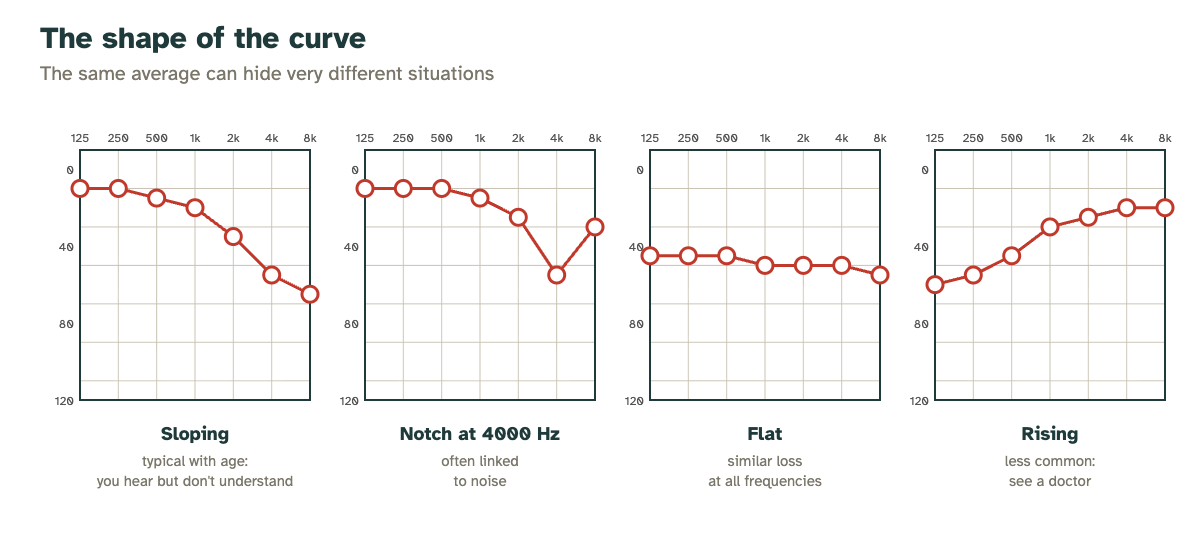
- Sloping down to the right: low pitches are heard well, high ones less so. This is the typical picture with age (presbycusis). The person “hears” but doesn’t understand well: it’s the high consonants that make words clear.
- With a “notch” around 4000 Hz: often a sign of noise exposure (work, music, gunfire).
- Flat: the loss is similar at all frequencies.
- Rising (worse on low pitches): less common, should always be checked by a doctor.
- Very different between the two ears: this too should always be checked by an ENT doctor.
Air and bone conduction: where the problem is
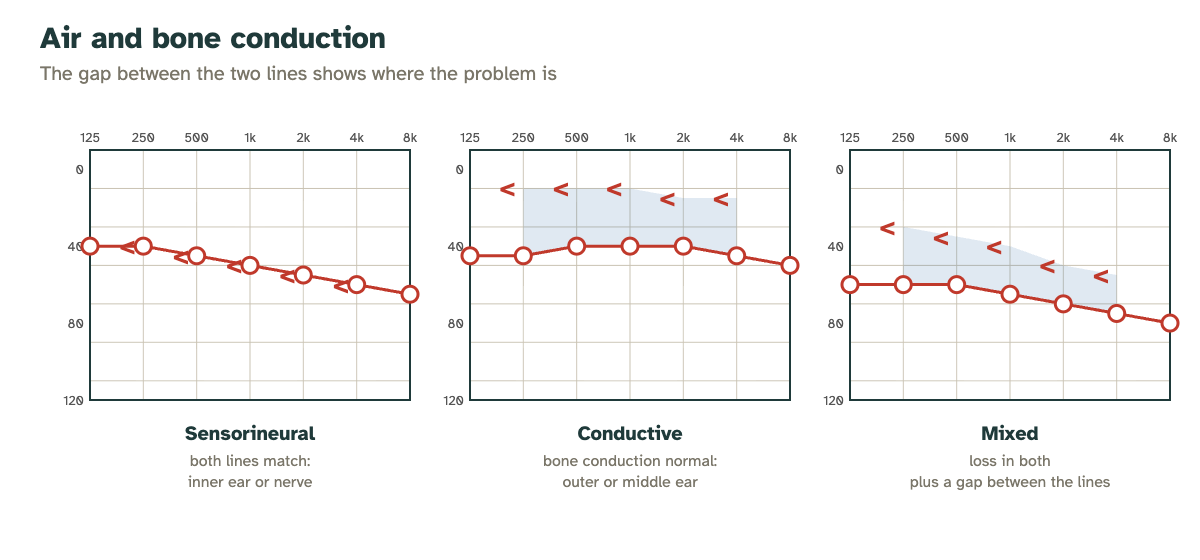
By comparing the two measurements you can tell where the loss is:
- Air and bone conduction overlap, both below normal: sensorineural hearing loss, linked to the inner ear or the nerve. It’s the most common type and the one treated with hearing aids.
- Bone conduction normal, air conduction worse (there’s a “gap” between the two lines): conductive hearing loss. The problem is in the outer or middle ear: earwax, ear infection, eardrum, ossicles. A doctor can often treat it.
- Both together: mixed hearing loss.
The speech test: understanding words, not just beeps
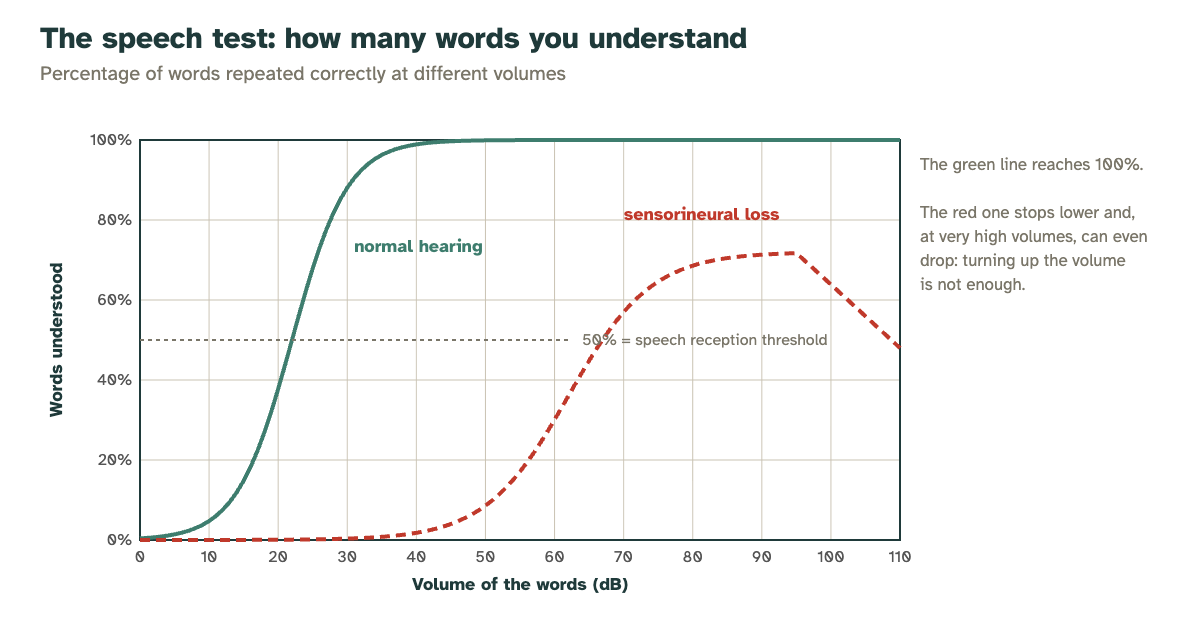
Hearing a beep doesn’t mean understanding a sentence. That’s why the pure-tone audiogram alone isn’t enough: you also need speech audiometry. You listen to words or sentences at different volumes and repeat them; the percentage of words understood is measured.
- Speech reception threshold: the volume at which you understand half of the words.
- Maximum speech understanding: the best percentage you can reach by turning up the volume. If it stays low (for example below 70–80%) even at high volume, the problem isn’t just “hearing softly” but also telling sounds apart: this must be known before choosing and fitting hearing aids.
- Speech-in-noise test: words are presented with background noise, like in a restaurant. It’s often the measurement that best reflects your everyday difficulties.
The speech test is also the most concrete way to check the results: repeated with hearing aids, it shows how much your understanding has improved.
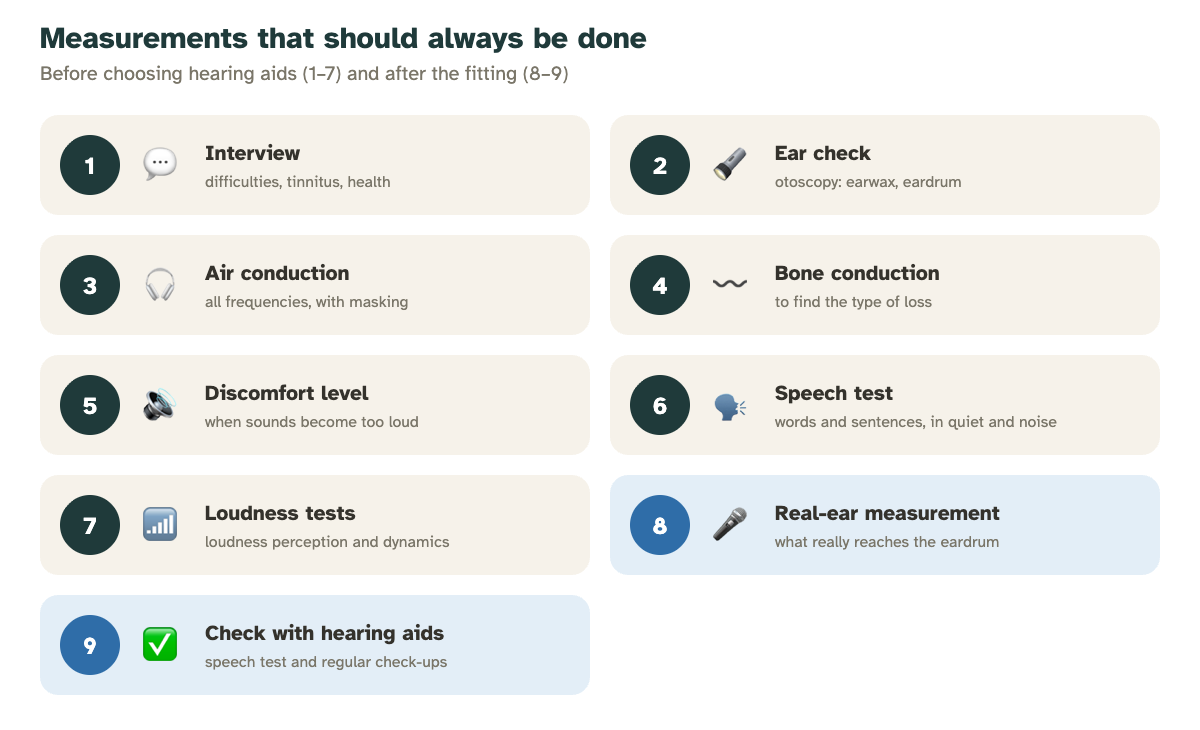
Measurements that should always be done
Before hearing aids are suggested, a good assessment should include at least:
- Interview (case history): in which situations you have difficulties, for how long, and whether you have tinnitus, dizziness, relevant illnesses or medication.
- Ear check (otoscopy): to rule out earwax or other problems in the ear canal and eardrum.
- Pure-tone air-conduction audiometry, on both ears and at all main frequencies, with masking when needed (noise in the other ear, to be sure the right ear is responding).
- Pure-tone bone-conduction audiometry, to find out the type of loss.
- Discomfort level: the volume that becomes unpleasant for you. It’s used to set the hearing aids so that loud sounds don’t bother you.
- Speech audiometry in quiet and, ideally, in noise, using both single words and sentences.
- Loudness tests (loudness perception): very specific tests that check whether the dynamics of your hearing are distorted.
And once the hearing aids are fitted:
- Real-ear measurement: with a small microphone in the ear canal, we check what really reaches your eardrum, instead of relying only on the software settings.
- Speech test with hearing aids and regular check-ups in the following weeks, again using both single words and sentences.
If there are particular signs (difference between the ears, conductive loss, sudden loss, pain, dizziness), a visit to an ENT doctor is also needed, who can perform tests such as tympanometry.
💡 Always ask for a copy
The audiogram and the speech test are your data: you have the right to a copy. You’ll need it to compare results over time, for a second opinion or if you change hearing care professional. And if something isn’t clear, ask for it to be explained: a good professional is happy to do so.
And the online test?
The hearing check on my website is a useful first step: it tells you whether a check-up is a good idea. But it doesn’t replace audiometry in a sound booth, with calibrated equipment and a professional, and it can’t measure bone conduction, the discomfort level or speech understanding in noise.
Got an audiogram and don’t understand it?
Write to me: I’m happy to explain what your results mean. To prepare for your first appointment you can also read the checklist for your first appointment with a hearing care professional.
This article is for information only and does not replace a medical visit or professional advice.
Was this helpful?