
You know that room where you sit down and immediately feel you can relax? And that other one where, after ten minutes, you’re already tired without knowing why? Often the difference isn’t the furniture, but the sound. In this article I explain how to make a room quieter and more welcoming, for example a reading corner where you can truly feel good.
In my work two worlds meet. As a hearing care professional, I often hear people say: “In a restaurant or in the kitchen I understand much less, even with my hearing aids.” As a sound engineer, I know that the room matters almost as much as the ears. The good news is that a few simple changes are enough, without expensive renovations.
Why some rooms “echo”
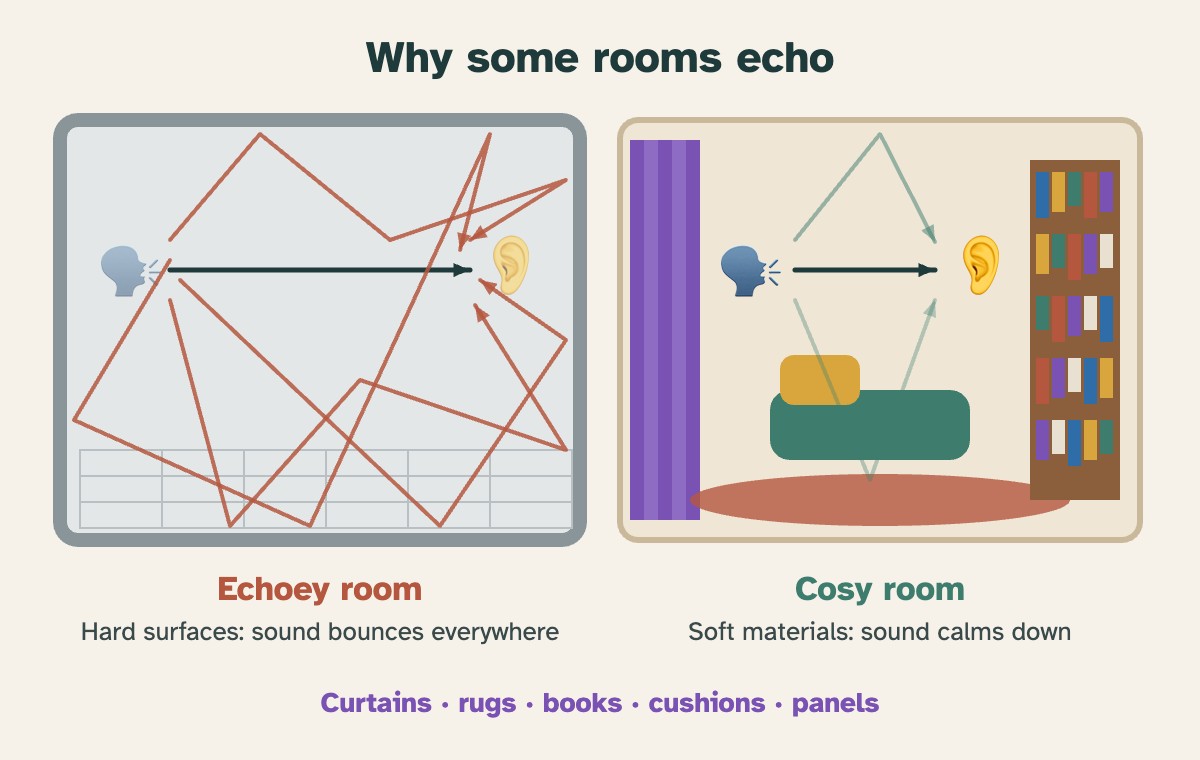
Sound doesn’t just travel straight to your ears: it bounces off walls, floor, ceiling and furniture. Each reflection arrives a moment later and overlaps the original sound. This effect is called reverberation.
Hard, smooth surfaces (tiles, glass, concrete, bare wooden floors, empty walls) reflect almost everything. Soft, porous materials (fabrics, rugs, books, upholstery) instead “absorb” part of the sound. In a room with too much reverberation voices blur, background noise seems louder and the brain has to work harder to understand. That’s why you get tired.
The hand-clap test
Stand in the middle of the room and clap your hands once, loudly. Listen to what happens right after:
- The sound dies away almost immediately: the room is already pleasant.
- You hear a long tail, like a “sssh”: there is a lot of reverberation.
- You hear a metallic ringing, like a spring: two parallel bare walls are probably bouncing the sound back and forth. That’s the first spot to treat.
Repeat the test after every change: it’s surprising how clearly you can hear the difference.
5 simple ways to absorb sound
- Heavy curtains: the thicker and fuller (with folds) they are, the more they absorb. They also help against cold from the windows. Even on just one wall they make a difference.
- A large rug: especially on wooden floors or tiles. With a felt underlay it works even better, also for the neighbours below.
- A full bookshelf: books of different sizes don’t just absorb, they “break up” reflections and spread them around. It’s one of the most beautiful acoustic treatments there is, and it’s called diffusion.
- Sofa, cushions and throws: every padded surface helps. A furnished room always sounds better than an empty one.
- Decorative acoustic panels: today they come in felt, micro-perforated wood or as pictures with a printed image. Put them on bare walls, especially opposite where you sit. You can also make them yourself: an article showing how is coming soon.
You don’t need to cover everything: a room that’s too “dead” feels unnatural. The goal is a balance where voices sound warm and clear.
Absorbing is not soundproofing: noise from outside
Note an important difference: curtains and panels improve the sound inside the room, but do little to stop noise coming from outside (traffic, neighbours, stairwell). For that you need mass and airtightness:
- Seals on doors and windows: noise often gets in through the gaps, not through the wall.
- Draught excluder under the door: it costs little and does a lot.
- A heavy curtain in front of the window, closed when you want to rest.
- The right position: place your armchair away from the wall next to the stairs or the noisy flat.
- Real soundproofing (new windows, extra wall layers) requires building work and a professional.
The household noises you no longer hear
We get used to many constant sounds and stop noticing them, but the brain still registers them: the fridge, the computer fan, the air conditioner, the hum of a lamp or a power adapter, the ticking of a clock. Try this: switch off everything you can for five minutes. If you feel relief, you’ve found a “silence thief”. Often it’s enough to move an appliance or choose a quieter model.
The recipe for your reading corner
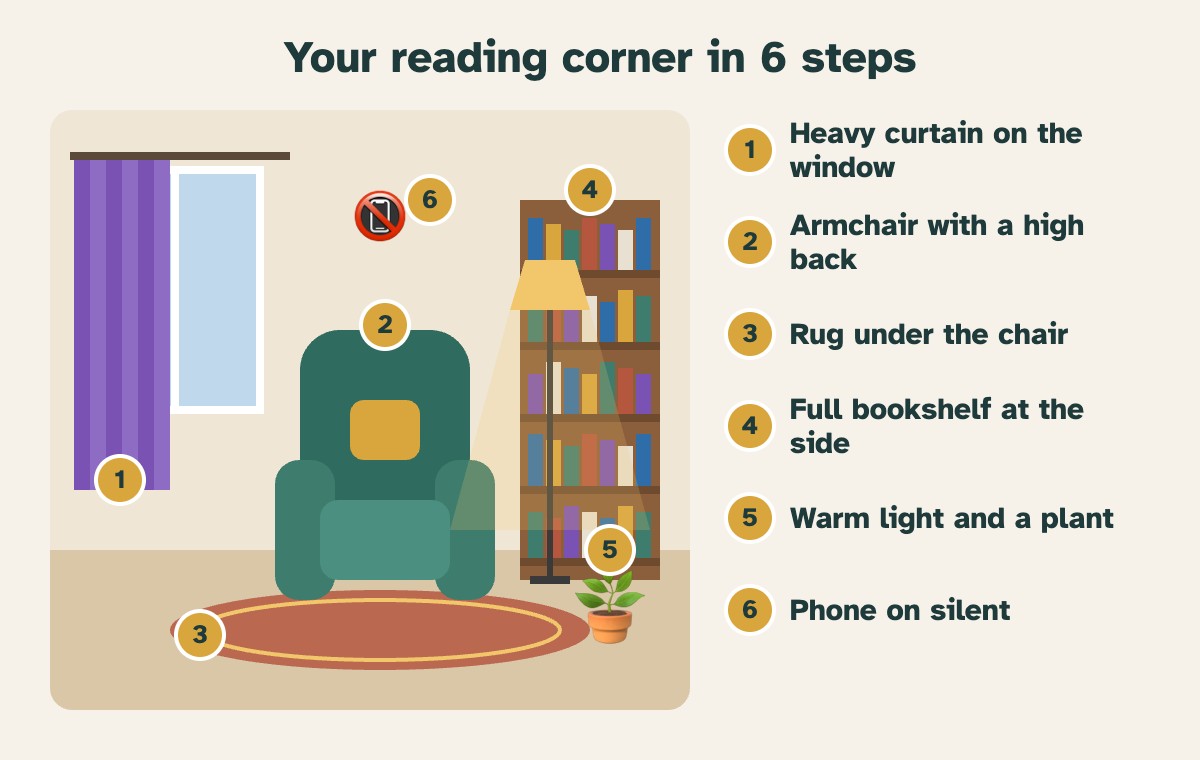
- Choose the corner furthest from the street-facing window and from doors.
- An armchair with a high back: it “wraps” you and reduces sounds from behind.
- A rug under the armchair and a bookshelf or panel at the side.
- A curtain or soft cloth on the opposite wall, if it’s bare.
- Warm, indirect light, a plant, a blanket: comfort is also visual.
- Phone on silent and out of reach.
If you wear hearing aids
For people who wear hearing aids, a room with little reverberation makes a huge difference: words come through more clearly and the hearing aids have to “clean up” the sound less. At the table you can help yourself too: a tablecloth instead of a bare table, sit with a wall behind you and the person you want to listen to opposite, away from the kitchen or the coffee machine. If a particular environment is difficult for you, talk to your hearing care professional: a dedicated program can often be set up.
Total silence? Not always the answer
People with tinnitus know it: in absolute silence the ringing seems louder. For many people a calm, steady background sound is better, like the sound of rain or waves, at low volume. With TinniAPP you can create and listen to relaxing sounds for free, right on your phone.
Coming soon: the listening room for music
This article is about comfort and rest. In an upcoming article we’ll go one step further: how to turn a room into a real listening environment for music, for a hi-fi experience. We’ll talk about speaker and listening position, how to control the bass and how to really soundproof the room. Follow me so you don’t miss it!
In short
- Reverberation makes rooms tiring and voices less clear.
- Curtains, rugs, books, upholstery and panels absorb sound.
- Against outside noise you need seals, airtightness and mass.
- Switch off the small constant noises around the house.
- With tinnitus, a light background sound is better than absolute silence.
Was this helpful?